Painterly illustration of the downtown Raleigh skyline rising above a sea of oak trees with a greenway path below

Living here · Raleigh

Living in Raleigh, NC: The Honest Pros and Cons (2026)

Raleigh just crossed 500,000 residents, the metro is a top-10 US grower, and the cost of living still runs 5% below the national average. Here is the honest brief on the City of Oaks — the strengths, the gaps, and the numbers behind both.

Updated July 3, 2026 · by the Trifecta Corporate Housing team

The 30-second verdict

Raleigh is the rare American city where the brochure claims mostly check out: a research-and-government job base that shrugs off recessions, schools that outperform the state by a wide margin, an absurd amount of green space for a state capital, and a cost of living that C2ER pegs at 5.2% below the national average — with median household income about 10% above the US median. In 2025 it crossed the 500,000-resident mark, one of only 39 US cities that size, and the metro ranked among the top ten fastest-growing in the country.

The honest catch: Raleigh is a city you drive. Less than 1% of workers commute by transit, there is no rail, and the first bus-rapid-transit line won't open until 2030. Add a long, humid summer and one of the worst pollen seasons in America, and you have the complete picture. We host relocating professionals, RTP assignees, and house-hunting families in our downtown furnished apartments every week — this is the briefing we give them.

500K+

Residents — Raleigh crossed the milestone in 2025 (Census)

94.8

C2ER cost-of-living index — 5.2% below the US average

~55,000

Jobs at Research Triangle Park, 20 minutes away

117 mi

Of greenway trails inside the city

The pros: why the Triangle keeps topping the rankings

1. A three-engine job market. Raleigh runs on an unusual mix: Research Triangle Park (7,000 acres, ~55,000 employees, 385+ companies, $25 billion in annual economic impact) twenty minutes west, state government downtown (24,000+ state employees in Wake County), and NC State University with its 39,000 students and engineering pipeline. Metro unemployment sat at 3.0% in spring 2026. Tech, biotech, government, education — when one cools, the others carry. (Worth knowing: Apple's much-announced RTP campus remains unbuilt — the state granted a four-year extension in late 2025 — so treat it as upside, not a given.)

2. Paychecks stretch. Median household income is $85,395 — about 10% above the US median — while the C2ER index puts overall costs 5.2% below average and Zillow ranks Raleigh the most rent-affordable major metro in America: a median-income household can afford 94.8% of listings, spending just 18.7% of income on the typical rent (~$1,694). Renting here in 2026 is about as favorable as big-metro America gets.

3. The greenest big city in the South, plausibly. The nickname is earned: 222 parks on 10,000+ acres, the Capital Area Greenway's 117 miles of trails threading the whole city, and 5,600-acre Umstead State Park ten miles from downtown with free entry. Living here, a real trail run or shaded bike commute is genuinely available from most neighborhoods.

4. Schools that deliver. Wake County Public Schools — the state's largest district and 14th-largest in the US at 160,000 students — posted a 90.6% four-year graduation rate for the class of 2025, well above the 87.7% state average, with over half its schools earning A or B performance grades. For relocating families this is routinely the deciding factor.

5. Free, good culture. The NC Museum of Natural Sciences (the Southeast's largest natural history museum) and the NC Museum of Art — plus its 164-acre outdoor park — charge nothing. The Carolina Hurricanes play at Lenovo Center, NC State fills stadiums, and the 2025 Michelin Guide's first Southern edition tagged nine Raleigh restaurants as Recommended, from Poole's Diner to Brewery Bhavana.

6. The Triangle multiplier. Durham's food-and-arts scene, Chapel Hill's college-town charm, and Duke and UNC's hospitals and events are all 25–35 minutes away. You live in one city and draw on three.

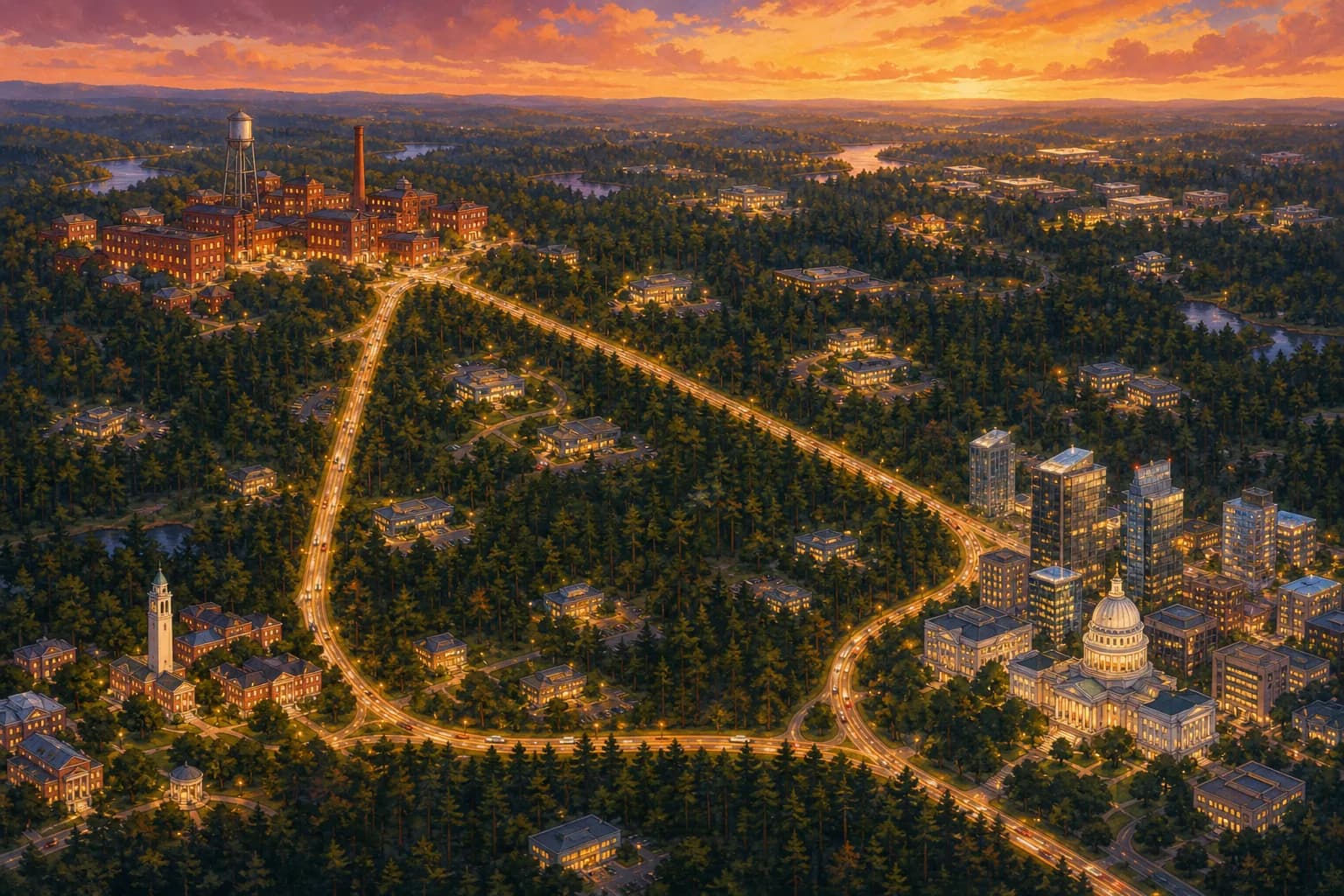
Storybook map of the Research Triangle: Raleigh, Durham, and Chapel Hill connected by highways around the pine forest of Research Triangle Park
The Triangle in one picture: Raleigh, Durham, and Chapel Hill ringing the pines of Research Triangle Park — one address, three cities’ worth of life.
A greenway trail tunnel under giant oaks in Raleigh with runners and a family on bikes, downtown skyline visible through the canopy
The City of Oaks earns its name: 117 miles of greenway run under canopies like this, and Umstead State Park sits ten miles from downtown.

The cons: what to price in before you move

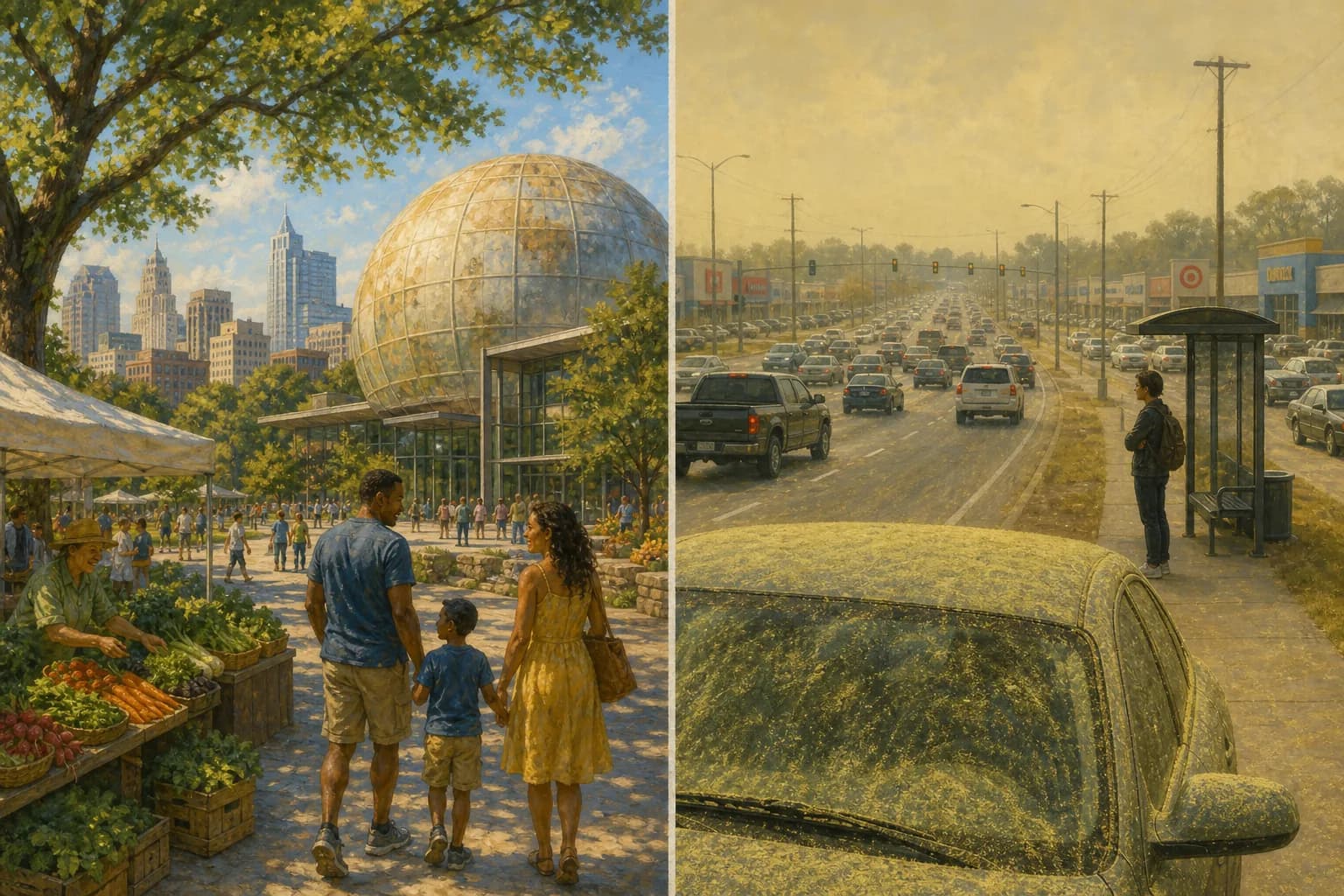
Split illustration contrasting Raleigh museum plazas and farmers markets with a five-lane suburban road, a lone bus stop, and pollen-dusted cars
Both Raleighs are real: free museums and market Saturdays — and five-lane arterials, thin transit, and the spring pollen film on every windshield.

1. This is a driving city, full stop. Mean commutes are a painless 23 minutes, but only 0.9% of workers get to work by transit. There is no light rail (and none coming), and the region's first bus-rapid-transit line — New Bern Avenue, 5.4 miles — has slipped to a summer 2030 opening. Downtown, Glenwood South, and a few close-in districts support car-light living; nearly everywhere else assumes a car per adult. Our Raleigh without a car guide maps the exceptions honestly.

2. Pollen season is nationally ranked, and not in a good way. The Asthma and Allergy Foundation of America's 2026 report ranks Raleigh the #7 worst allergy city in the United States. Every April, a visible yellow-green film of pine pollen coats cars, porches, and patios for weeks. Allergy sufferers: budget for it, medically and emotionally.

3. Summers are long and getting hotter. July normals hit 90.8°F with full Southern humidity — and July 2025 was the hottest month ever recorded at RDU. June through mid-September is genuinely tropical; the greenways go quiet by 10 a.m.

4. Buying in has gotten expensive faster than renting. The typical home value is about $438,000 (Zillow, spring 2026) — and Zillow estimates the income needed to buy in Raleigh runs 16% above the US requirement, even as renting stays cheap. The result is a market where newcomers rent longer than they planned. (Prices did ease 2.2% over the past year, for what it's worth.)

5. It's growing faster than its infrastructure. Nearly 40,000 new residents in five years means construction cones, school reassignments, and roads designed for a smaller city. The flip side of every "top place to live" ranking is the traffic that follows it.

6. Nightlife is modest, and briefly headless. Raleigh is livelier than its reputation — Glenwood South, the Warehouse District, a real music calendar — but it is not Austin or Nashville, and 2026–27 brings a concrete gap: Red Hat Amphitheater plays its final season through October 2026, with its 6,000-seat replacement a block away opening in spring 2027. One more quirk: hurricane remnants brush the Triangle every few years (Fran in 1996 remains the benchmark), bringing wind and flood rain rather than coastal fury — worth knowing, not fearing.

So — should you move to Raleigh?

Raleigh fits you well if: you work in tech, biotech, research, government, or academia; schools and parks rank high on your list; you want above-average income against below-average costs; and a 23-minute drive doesn't bother you.

Think harder if: you want to live car-free (the options are few and specific), spring allergies wreck you, or you need big-city nightlife density.

Our standing advice mirrors what we tell every relocating guest: rent before you buy, and stay before you rent. Raleigh's neighborhoods — ITB's leafy streets, North Hills' new-urban polish, downtown's walkable core, the suburban school-district favorites — reward on-the-ground scouting, and the buy-in premium makes a wrong purchase expensive. A furnished month downtown lets you test the RTP commute at real rush hour, walk the greenways, and tour schools before committing. That bridge is exactly what we operate: month-to-month furnished apartments in downtown Raleigh, everything included, no annual lease.

Scout Raleigh from a real home base

A furnished month downtown — full kitchen, parking, in-unit laundry — while you test commutes and tour neighborhoods. Book direct with the local owner-operator.

Good to know

Frequently asked questions

Is Raleigh, NC a good place to live?

By most measures, yes: a diversified tech/government/university job market anchored by Research Triangle Park, cost of living 5.2% below the national average against incomes 10% above it, a 90.6% graduation-rate school district, and 117 miles of greenways. The main trade-offs are near-total car dependence, a long humid summer, and a top-10-worst national pollen season.

What salary do you need to live comfortably in Raleigh?

Zillow rates Raleigh the most rent-affordable major US metro — the typical rent (~$1,694) takes just 18.7% of the median income. A single earner around $60,000–$70,000 rents comfortably; buying is a different story, requiring roughly 16% more income than the US average home.

Is Raleigh growing fast?

Yes. Raleigh crossed 500,000 residents in 2025 (506,306, one of only 39 US cities that size), the Raleigh-Cary metro ranked in the top 10 nationally for growth rate, and U-Haul ranked it #8 for one-way move-ins. It is not, however, literally the "fastest-growing US city" — that claim outruns the data.

Do you need a car in Raleigh?

Almost certainly. Only about 0.9% of Raleigh workers commute by transit, there is no rail, and the first bus-rapid-transit line is not due until 2030. Downtown and a few close-in districts support car-light living; the rest of the city assumes you drive.

What are the downsides of living in Raleigh?

Car dependence and thin transit, a #7-in-the-nation pollen season every spring, 90°F+ humid summers (July 2025 was the hottest on record), home-buying costs that now require above-average income, and growing-pains congestion. Nightlife is decent but modest, with the Red Hat Amphitheater dark between late 2026 and spring 2027 during its relocation.

Is Raleigh or Durham better to live in?

They trade punches: Raleigh is bigger, greener, more polished, with stronger schools; Durham is funkier, foodier (four Michelin-recommended restaurants), and slightly cheaper. Commutes to RTP are similar. Most relocators pick on vibe — our Raleigh vs Durham guide breaks the decision down honestly.

What is the weather like in Raleigh year-round?

Four real seasons tilted warm: July highs near 91°F with humidity, January lows around 32°F, about 5 inches of snow in a typical winter, a spectacular (and pollen-heavy) spring, and a long mild fall. NOAA normals put it among the more pleasant Southeast climates — if you can handle the summer.

Your stay

Moving to Raleigh? Scout it properly first.

A furnished month in downtown Raleigh — full kitchen, parking, laundry — while you test the commute and tour neighborhoods. Booked direct with the local owner-operator, no annual lease.