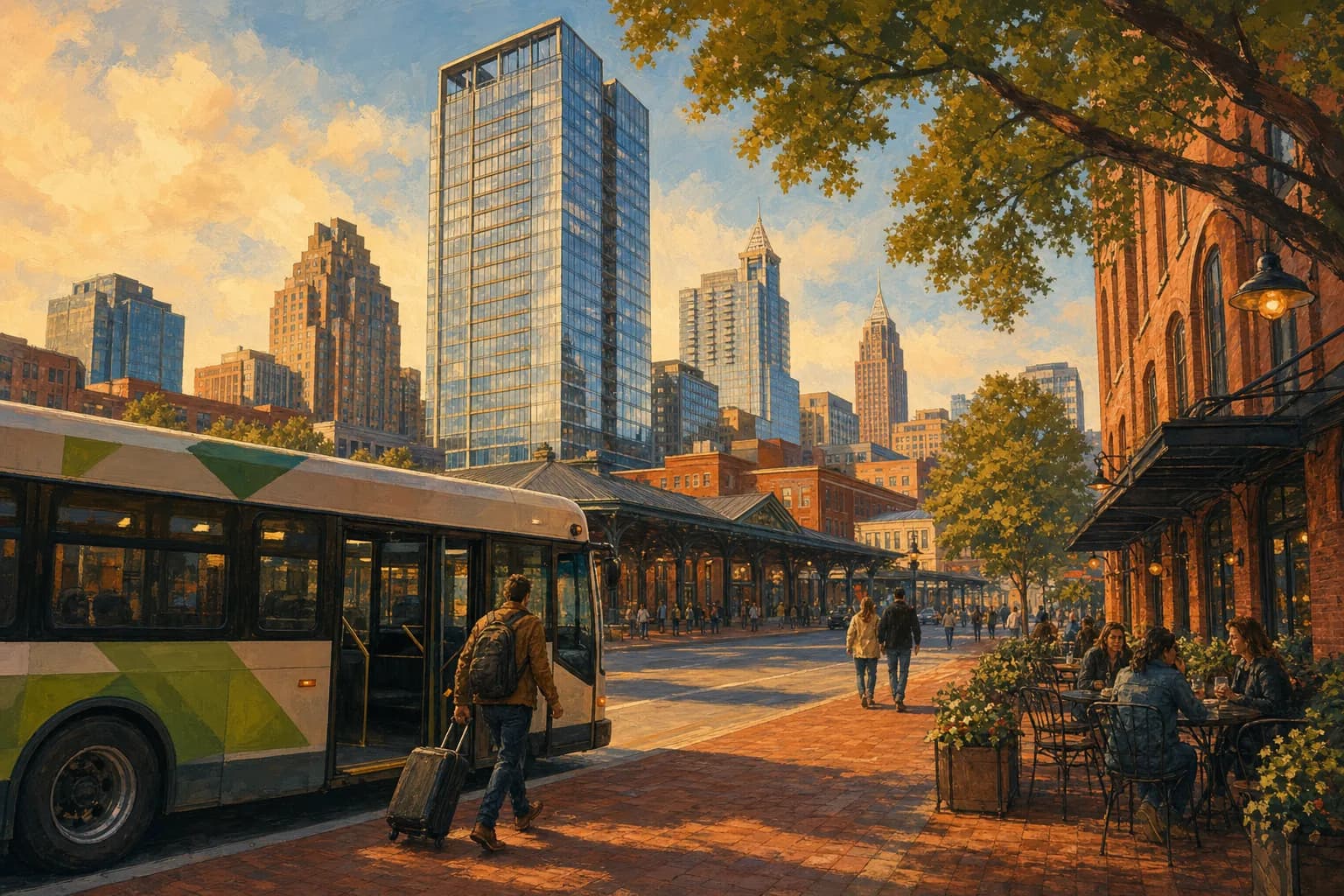
Illustration of a GoTriangle bus arriving at Raleigh Union Station with the 400H tower and downtown Raleigh skyline rising behind it

Getting around · Raleigh

Raleigh Without a Car: The Extended-Stay Guide

You can land at RDU, reach downtown for $2.50, and live weeks without touching a steering wheel. Here is exactly how — with the real fares, the real walking distances, and the one commute where you will still want a car.

Updated June 10, 2026 · by the Trifecta Corporate Housing team

From RDU to downtown Raleigh: the $2.50 ride

RDU sits about 13 miles northwest of downtown Raleigh, and you have two realistic ways to cover them.

GoTriangle Route 100 is the public-transit answer, and it's better than most cities' airport buses: a single ride costs $2.50 ($1.25 discount fare; fares cap at $5 a day if you pay with the Umo app). Downtown, the route serves GoRaleigh Station and West Street at Raleigh Union Station, then threads the Hillsborough Street corridor — which puts its downtown stops within a few blocks of our apartments at 400H.

One wrinkle worth knowing before you stand at the wrong stop: GoTriangle splits the airport leg by time of day. Weekday and Saturday daytimes (roughly 6 a.m. to 6 p.m.), Route 100 connects through the Regional Transit Center, where the dedicated RDU Shuttle covers the short hop to the terminals. Evenings after about 6:30 p.m., and all day Sunday, Route 100 pulls straight up to Terminals 1 and 2. Check the GoTriangle trip planner or the Transit app for your exact departure — some runs serve the terminals directly, others connect via the shuttle.

Rideshare is the convenience answer: Uber's own published estimate for RDU to Raleigh averages about $31 and 19 minutes (surge and time of day move it). For a party of two with luggage after a long flight, that's often money well spent. For a solo traveler on a Tuesday afternoon, the bus costs less than a tenth as much.

RDU to downtown Raleigh, compared (verified June 2026)
OptionCostTimeGood to know
GoTriangle Route 100$2.50 per rideRoughly 30–50 min depending on the runServes GoRaleigh Station + Union Station; daytime trips may transfer to the RDU Shuttle at the Regional Transit Center; evenings + Sundays run direct to the terminals
Uber / Lyft~$31 average (Uber’s published route estimate)~19 minFastest door-to-door; price swings with surge and time of day
Rental carDaily rate + fuel~20 min driveOnly worth it for an RTP commute or daily hospital runs — downtown errands don’t need it, and 400H guests already have secured parking included if you do rent

The hybrid move many of our long-stay guests settle on

Take a rideshare in on arrival day (you're tired, you have luggage) and the $2.50 bus out for departures you can plan. Over a 60-night assignment with a trip home in the middle, that habit alone saves real money versus defaulting to rideshare every time.

Is downtown Raleigh walkable? The honest answer

Yes — with a boundary. Downtown Raleigh scores 91 out of 100 on Walk Score, "Walker's Paradise" territory, and within that core you genuinely do not need a car: groceries, coffee, offices, the convention center, Union Station, and three districts of restaurants are all on foot.

Our Raleigh apartments are in 400H, the 20-story tower at 400 Hillsborough Street that sits where the Warehouse District, Glenwood South, and the Fayetteville Street core meet — which is exactly the position you want for a car-free stay. Step out the door and you're a few blocks from Union Station in one direction and the museums and capitol blocks in the other.

The boundary: walkability drops off fast once you leave the downtown core. North Hills, Crabtree, and the RTP office parks are car territory. If your daily destination is downtown, car-free works beautifully; if it's a suburban office park, read the verdict table at the end of this guide first.

91

Downtown Raleigh Walk Score — Walker’s Paradise

$1.25

GoRaleigh single ride around town ($2.50 day pass)

$2.50

GoTriangle Route 100 to RDU

Included

Secured parking at 400H, if you bring a car anyway

A note on the R-LINE, because older guides get this wrong. Raleigh's downtown circulator bus is still described as "free" all over the internet — it isn't. GoRaleigh resumed fare collection in September 2024, so the R-LINE costs the standard $1.25 GoRaleigh fare, and in June 2026 the city announced it will suspend the route entirely from August 9, 2026 for up to 18 months while it rethinks downtown circulation. Plan around it: the downtown core is compact enough that walking covers nearly everything in this guide, GoRaleigh's regular routes still cross downtown ($1.25 a ride, $2.50 day pass), and scooter and bike share fill the short-hop niche the circulator used to serve.

Groceries, coffee, and a place to work — on foot

The question that actually decides whether a month car-free is pleasant or annoying is not nightlife — it's groceries.

  • Weaver Street Market anchors The Dillon in the Warehouse District — a co-op grocery with produce, a hot bar, and everyday staples, a few blocks' walk from 400H.
  • Publix at 417 W. Peace Street (Smoky Hollow, at Peace and West) is downtown Raleigh's full-size national supermarket — roughly a 15-minute walk up the West Street side of downtown, an easy haul home with a backpack.
  • Coffee is everywhere between them — the Warehouse District and Fayetteville Street corridor are dense with independent shops, so the problem is choosing, not finding.

For work, you may not need to leave at all: every Trifecta apartment includes high-speed Wi-Fi and a laptop-friendly workspace, and our 400H units have a dedicated desk. When you want a change of scenery, downtown's coworking options and coffee-shop tables are all inside the same walkable core.

Every unit also has a full kitchen with cookware and an in-unit washer and dryer — which is the quiet reason car-free works better in a furnished apartment than a hotel room. You're walking home with groceries to an actual kitchen, not a kitchenette, and you're never driving to a laundromat. Here's everything that comes with the apartment.

Arriving by train instead?

Amtrak serves Raleigh Union Station in the Warehouse District — the Piedmont and Carolinian lines connect Raleigh with Durham, Greensboro, and Charlotte daily. From the platform, 400H is a short walk, no ride needed at all. Comparing Triangle cities first? See Raleigh vs Durham: where to stay.

Stay in the middle of all of it

Our 400H apartments put the Warehouse District, Glenwood South, and Fayetteville Street on foot — booked direct with the owner-operator, live availability and instant confirmation.

Parking, if you do end up with a car

Plenty of "car-free" stays involve a car for a weekend — a rental for a beach trip, a visiting spouse, a mid-stay IKEA run. Two things to know.

If you're staying with us: 400H stays include secured on-site parking — so a rental weekend costs you nothing extra in parking, and there's no nightly garage math.

If you're parking around downtown: the City of Raleigh's deck rates are genuinely reasonable, per raleighnc.gov as of June 2026:

City of Raleigh downtown deck pricing (raleighnc.gov, June 2026)
SituationWhat it costs
Hourly (city decks)$2 per hour or part, to a maximum of $14 per day
Weeknights, 7 p.m.–7 a.m.Free at participating city decks
Saturday and SundayFree all day at participating city decks
First two hours, daytimeFree once per day at five participating city decks — a City Council program most recently extended through June 30, 2026; check raleighnc.gov before relying on it
Monthly, unreserved$125 per month
Monthly, reserved$190 per month
Staying at 400HSecured on-site parking included with your stay

The nights-and-weekends rule is the one visitors miss: if your car mostly sits while you work, a downtown weekend with a rental can cost you nothing in parking at a participating city deck. We're keeping this to one section on purpose — for deck-by-deck maps and the current program fine print, raleighnc.gov's parking pages are the authoritative source.

What’s coming: bus rapid transit on New Bern Avenue

Raleigh's transit map is about to get its biggest upgrade in decades. Wake BRT: New Bern Avenue — the city's first bus-rapid-transit line — is under construction now, with the first construction contracts awarded in 2025 and crews working along the corridor. It will run dedicated, frequent service along New Bern Avenue between downtown and New Hope Road — the same avenue that's home to WakeMed's flagship Raleigh campus.

The city hasn't published a firm public opening date, so we won't invent one — but the direction is clear: the downtown-to-WakeMed trip is the corridor Raleigh is investing in first. For medical stays today, plan on a car or rideshare for daily hospital runs; we'll update this guide when BRT service actually opens.

So — do you actually need a car in Raleigh?

After eight years hosting long-stay guests, our honest Raleigh scorecard, by guest type:

Car-free verdict by guest type
Your situationVerdictWhy
Downtown office assignmentNo car neededWalk to work, Route 100 for flights, everything else on foot — car-free at its easiest
RTP commuteBring or rent a carResearch Triangle Park is about a 20-minute drive from downtown Raleigh and its campuses sprawl; transit exists but a car wins on time, every day
Medical stay (WakeMed, Duke Raleigh, UNC Rex)Usually yes, for nowDaily appointments reward a car or budgeted rideshares; the New Bern Avenue BRT will eventually change this for WakeMed
NC State campus visitProbably notRoute 100 and the Hillsborough Street corridor link downtown and campus directly
Event or weekend tripNo car neededThe convention center, Red Hat Amphitheater, and the Fayetteville Street districts all sit in the walkable core, an easy walk apart

One honest scope note: in Raleigh we operate two one-bedroom apartments at 400H (each sleeps up to 3), from $89/night — from-rates; your exact quote comes from the live availability search, since pricing varies by unit, dates, and number of guests. They book out precisely because of the location this guide describes, so if your dates are fixed, check availability early. Need more space, or Durham instead? Our Durham car-free guide covers the loft side of the Triangle — including the Amtrak station that sits inside our buildings' complex.

Good to know

Frequently asked questions

How do I get from RDU to downtown Raleigh without a car?

GoTriangle Route 100 — $2.50 per ride. Evenings after about 6:30 p.m. and all day Sunday it runs directly between the RDU terminals and downtown (GoRaleigh Station and Union Station); weekday and Saturday daytimes, trips connect via the RDU Shuttle at the Regional Transit Center. A rideshare averages about $31 and 19 minutes if you’d rather skip the wait.

How much does an Uber from RDU to downtown Raleigh cost?

Uber’s own published route estimate averages about $31 for the roughly 13-mile, 19-minute trip — more during surge windows, sometimes less off-peak. The bus alternative, GoTriangle Route 100, is $2.50.

Is downtown Raleigh walkable?

Genuinely yes — downtown Raleigh scores 91 out of 100 on Walk Score, "Walker’s Paradise" territory. Groceries, coffee, offices, Union Station, and three dining districts sit inside the walkable core. Walkability drops fast outside downtown, so base yourself centrally if you’re going car-free.

Is the R-LINE downtown circulator in Raleigh still free?

No — despite what older guides say, GoRaleigh resumed fare collection in September 2024, so the R-LINE costs the standard $1.25 GoRaleigh fare. More importantly, the city announced in June 2026 that the route will be suspended from August 9, 2026 for up to 18 months due to low ridership. Downtown is compact enough that most of it is walkable; GoRaleigh’s regular routes and scooter share cover the rest.

Is parking free in downtown Raleigh overnight?

At participating City of Raleigh decks, yes: deck parking is free from 7 p.m. to 7 a.m. on weeknights and all day Saturday and Sunday, with daytime rates of $2 per hour up to a $14 daily max (per raleighnc.gov, June 2026). Guests at our 400H apartments don’t need any of this — secured on-site parking is included.

Can I commute from downtown Raleigh to RTP without a car?

It’s possible — GoTriangle connects downtown to the Regional Transit Center in RTP — but the park’s campuses sprawl, and most daily RTP commuters are happier with a car. If RTP is your destination every day, weigh basing in Durham or budgeting for a rental.

Can I get to Raleigh by train instead of flying?

Yes — Amtrak’s Piedmont and Carolinian lines serve Raleigh Union Station in the Warehouse District, with daily connections to Durham, Greensboro, and Charlotte. From the platform you can walk to our 400H apartments without ever hailing a ride.

Is there a grocery store in downtown Raleigh?

Two good ones: Weaver Street Market, a co-op grocery at The Dillon in the Warehouse District, and a full-size Publix at 417 W. Peace Street in Smoky Hollow. Both are walkable from the downtown core — which is what makes a car-free month here practical.

Your stay

Land at RDU. Drop your bags downtown. Skip the rental counter.

Furnished one-bedroom apartments at 400H in downtown Raleigh, from $89/night — full kitchen, in-unit laundry, dedicated desk, and secured parking included if you bring a car anyway. Booked direct with the owner-operator: no middleman markup, instant confirmation, and a real person to talk to if plans change.